What 150 AMRAP Workouts Reveal About Programming
Analyzing 150 AMRAP missions reveals that programming density fundamentally changes based on the duration of the AMRAP. Round density (# of exercises + reps per exercise) doubles from a 5-minutes to 20-minutes —scaling from 2 movements and 27 reps to 4 movements and 60 reps. The two workouts are distinct sports demanding entirely different metabolic pathways.
Why Round Density Dictates the Training Stimulus
Evaluating workout statistics from a verified library of 150 AMRAP workouts, which encompasses 73 distinct bodyweight movements across four time domains and seven training stimuli, exposes a structural reality in physical programming. The architecture of a mission is heavily dictated by its duration. Shorter caps force a severe reduction in movement variety because physical transitions consume a disproportionate percentage of the total work time.
| Time Cap | Movements Per Round | Total Reps Per Round |
|---|---|---|
| 5 Minutes | 2.1 | 27 |
| 10 Minutes | 2.6 | 39 |
| 15 Minutes | 3.0 | 55 |
| 20 Minutes | 4.0 | 60 |
In a 5-minute mission, every transition between a lower-body hinge and an upper-body press requires a change in elevation, a massive shift in localized blood flow, and a complete reset of physical tension. If a programmer forces four distinct movements into a 5-minute cap, the athlete spends more time managing transitions than executing actual repetitions. Therefore, the average 5-minute AMRAP workout contains only 2.1 movements totaling 27 repetitions per round. The primary objective is continuous mechanical tension and severe metabolic stress without the relief of transitioning.
By the time the time cap extends to 20 minutes, the structural density expands to 4.0 movements and 60 repetitions. This expanded round density deliberately distributes muscular fatigue across multiple planes of motion and distinct muscle groups. Distributing the load prevents localized muscular failure from bottlenecking the systemic cardiovascular effort. The athlete continues moving precisely because the fatigue is spread across the entire organism rather than concentrated in a single prime mover. Analyzing 20-minute AMRAP workouts shows that this architectural expansion is a biological necessity to sustain work capacity over longer durations.
How Energy Systems Shape Mission Architecture
The human body generates energy through three primary metabolic pathways: the phosphagen pathway, the glycolytic pathway, and the oxidative pathway. The phosphagen system dominates maximal-powered, explosive efforts lasting under 10 seconds. The glycolytic system acts as the bridge, fueling moderate-to-high power outputs lasting from roughly 30 seconds up to three minutes. The oxidative, or aerobic, system sustains continuous, lower-powered activities exceeding three minutes.
While all three metabolic engines run concurrently during exercise, the intensity and duration of the mission dictate which pathway bears the primary functional load. A 5-minute AMRAP operates as an extended, brutal sprint. It pushes the athlete deep into the glycolytic pathway, resulting in rapid lactate accumulation and immense metabolic strain. The programming naturally limits movement variety because the athlete operates near the absolute threshold of both muscular failure and cardiovascular exhaustion simultaneously. The biological goal is to maximize the work rate before the glycolytic system reaches its absolute limit.
Conversely, a 20-minute AMRAP functions primarily as an oxidative endurance event. The primary driver is the aerobic system. Repeated high-effort bouts over this extended duration raise systemic oxygen demand and stimulate mitochondrial biogenesis, which involves the activation of the AMPK, PGC-1α, SIRT1, and ROS pathways. This cellular signaling forces the body to adapt by building denser, more efficient mitochondrial networks to process oxygen.
Treating a 20-minute mission with the aggression of a 5-minute sprint ignores human physiology and invariably leads to systemic collapse. The athlete must maintain a pace that keeps lactate clearance roughly equal to lactate production. This metabolic reality explains why round density must increase in longer domains; varying the movements provides local muscle groups with micro-recoveries while the central cardiovascular system remains under a constant, unrelenting oxidative load.
[OPINION: whether you actually agree with this — Justin to confirm]
The Pace Variance Index and Athlete Execution
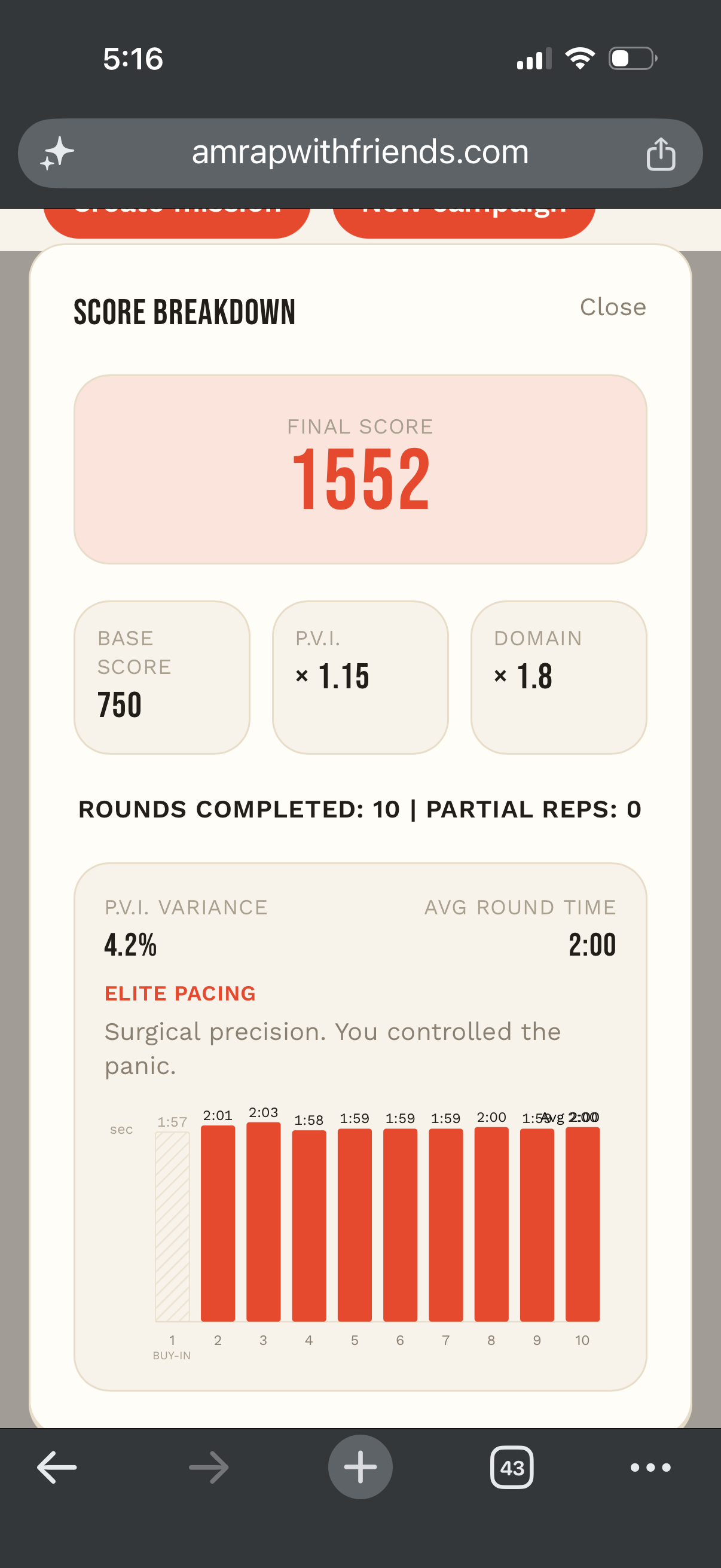
The defining metric of athlete execution in a time-capped mission is pacing. To quantify this operational efficiency, the Pace Variance Index (PVI) measures the stability of an athlete’s work output over time. The formula is calculated as: (slowest round − fastest round) ÷ average round × 100. The first round is deliberately excluded from the calculation to account for the initial, unsustainable adrenaline spike that universally occurs when the timer starts.
| Pace Variance Index (PVI) | Performance Band |
|---|---|
| Under 10% | Elite Pacing |
| 10–20% | Standard |
| 20–30% | Power Leak |
| Over 30% | Collapse |
The most common execution error in high-intensity functional training is opening with an aggressive, unsustainable velocity. An athlete who secures five rounds in the first five minutes of a 20-minute mission is not demonstrating superior fitness; they are mathematically guaranteeing their own collapse. Proper execution of a 20-minute AMRAP requires the athlete to treat it similarly to an 80-minute continuous effort. Mastering proper AMRAP pacing dictates that the athlete finds a rhythm where the final rounds perfectly match the speed of the second round.
When the PVI eclipses 30%, it indicates that the athlete redlined their glycolytic system too early and failed to transition smoothly into oxidative dominance. At this point, the athlete is reduced to staring at the clock, waiting for the central nervous system to permit another repetition. Elite pacing, indicated by a PVI under 10%, demonstrates a profound understanding of one’s own metabolic threshold. The athlete establishes a steady cadence that allows for continuous movement with minimal breaks, generating massive total work volume through mechanical consistency rather than erratic sprinting.
I went out too fast on a 10-minute AMRAP and fundamentally died in the last 3 rounds, I had to take a 5-7 second rest before starting V-ups and was slowing down on all my exercises. Then I paced a 20-minute AMRAP correctly and hit every round at ~2:00 and finished strong. I completed 1550 reps in the 20 minute round at an elite pace and did less then 400 reps in a 10 minute AMRAP. Different exercises, but body weight none-the-less.
Movement Selection Within the Attrition Grid
An audit of the 150-workout dataset reveals a heavy reliance on a narrow selection of high-turnover, foundational movement patterns. Complex, highly technical movements are deliberately minimized in effective programming.
| Movement | Frequency in Workouts |
|---|---|
| Air Squats | 16.7% |
| Jumping Jacks | 14.0% |
| Mountain Climbers | 10.7% |
| High Knees | 10.0% |
| Skater Jumps | 10.0% |
These specific movements dominate the programming for highly logical reasons. They require zero equipment, they allow for instantaneous transitions, and they elicit rapid heart rate elevation without demanding high technical proficiency under extreme fatigue. Foundational exercises like the air squat provide a massive metabolic return on investment.
When an athlete is 17 minutes into a 20-minute mission, peripheral fatigue and central nervous system depletion severely compromise spatial coordination and balance. Programming highly technical Olympic lifts or complex gymnastics under these deteriorated conditions spikes the injury risk significantly. Fatigue degrades mechanical form, and pushing to failure on complex movements guarantees structural breakdown.
The verified data confirms this principle of simplicity. Out of the 73 distinct movements cataloged in the library, 20 appear in exactly one workout. The median movement appears in only four workouts out of 150. Exotic movements provide occasional flavor and specific joint angle variance, but the core engine of effective, high-yield programming relies heavily on a narrow, proven set of functional, high-output exercises.
Architecting Multi-Week Campaigns
High-intensity training requires rigid structural oversight to prevent systemic overtraining and to ensure measurable physiological adaptation. Shifting focus from the micro-level of a single mission to the macro-level requires strict scheduling. Campaigns within this ecosystem run strictly for 2, 4, 6, 8, or 12 weeks, consisting of one to five missions per week.
A properly structured 8-week campaign relies on three specific operational roles to guide the athlete: the benchmark, the retest, and the easy day. The benchmark establishes the baseline capability of the metabolic engines on day one. An 8-week campaign strictly tests this benchmark in weeks 1, 4, and 8. Without this rigid retest schedule, fitness adaptations are merely guessed at, not proven.
Crucially, campaigns running under 8 weeks schedule no deload period. The duration is brief enough that the athlete can sustain the accumulating systemic fatigue without requiring a programmed reduction in volume or intensity. Interventions lasting beyond 8 weeks require deloads to shed accumulated fatigue and allow the central nervous system to recover fully before the next intensity block.
Accountability drives adherence. Historical data from [NUMBER: members at San Diego Core Fitness — Justin to confirm] members proved that physical isolation breeds failure. In the digital space, this requires specific social infrastructure. Athletes utilize a rally link to access the rally point, assembling their squad before the physical timer initiates. This digital assembly mirrors the mandatory accountability of a physical formation, ensuring that the prescribed work is executed entirely and to standard.
Next Actions for the Operator
Athletes and programmers must stop applying 5-minute tactical strategies to 20-minute endurance caps. To correct current programming errors and eliminate power leaks, review the comprehensive workout statistics to establish accurate baseline expectations for round density and volume. Following that review, deploy an 8-week campaign, distribute the rally link to the squad, and execute a benchmark mission that demands strict adherence to a Pace Variance Index below 20%.
Keep going
About the author
Justin Fassio — Certified Master Fitness Trainer since 1998. Owned San Diego Core Fitness, co-founded gymgo and aiworkoutgenerator.com, and builds AMRAP With Friends.
Run an AMRAP with your friends
One shared countdown, one leaderboard, everyone on the same clock — wherever they are training.